
Haridwar & Pehowa Pind Daan Trip From Chennai: Our Guide
📅 Updated as of 3 Oct 2026. We made this trip in October 2025; prices below are what we paid then. Check current fares and hotel rates before you plan yours.
🔄 What changed (3 Oct 2026): added the trip dates and the card we used for the flight booking.
Life’s journeys aren’t always about aspirational luxury or exotic destinations. Sometimes, they call us to our roots, to moments of profound remembrance, culture, and family. Recently, a solemn occasion – the passing of an Elder in our family – led us on an unexpected but deeply meaningful pilgrimage from Chennai to the sacred lands of Haridwar and Pehowa.
This wasn’t a ‘points challenge’ in the traditional sense, as this was an entirely paid journey. However, it stands as a testament to how thoughtful planning and strategic use of premium credit cards can provide comfort, efficiency, and even future rewards, even during life’s most significant and difficult passages. Join us as we recount this journey, delving into ancient rituals, tracing ancestral lineages, and discovering the profound spiritual heritage of India – lessons vital for our generation and those to come.
A note on our journey:
This article chronicles a deeply personal and spiritual journey, sharing our experiences, observations, and understanding of ancient rituals and cultural practices. The interpretations and descriptions shared are based on our personal beliefs, family traditions, and what we learned during our pilgrimage. Our intention is purely to share this meaningful experience and its insights, and we want to assure our readers that this account is offered with the utmost respect and reverence, and is not intended to cause any harm, disrespect, or misrepresentation of any religion, belief, or individual perspective.
Day 1: Chennai to Haridwar – A Journey Underway (2 October 2025)
Our journey began swiftly on 2 October 2025 from Chennai, a testament to the need for quick, efficient travel during sensitive times.
Flights: Strategic Bookings for Convenience
- Chennai to Delhi (One-way): Booked just a week before travel through the Axis Bank Travel EDGE portal, paid with my Axis Magnus for Burgundy card, our one-way flight cost ₹7,599 per person for two travelers. While not a points redemption, booking via a card’s travel portal allows for seamless management and often earns accelerated rewards.
- Tip for Readers: Even on paid travel, using credit card travel portals can yield bonus points, offering future redemption opportunities.
- Flight Details: Our morning Air India flight departed Chennai at 6:50 AM and landed in Delhi by 9:50 AM, ensuring we had ample time for the onward journey.
Delhi to Haridwar: Road Trip to the Holy City
- Upon landing in Delhi, we opted for an Ola cab to Haridwar. The base fare was ₹3,500, but with tolls and state taxes, the total came to approximately ₹5,400. This 4-5 hour drive provided a necessary transition from the bustling city to the spiritual tranquility of Haridwar.
- Travel Insight: For such distances, pre-booking a comfortable taxi or a car rental with a driver is advisable, especially when traveling under emotional circumstances.
Haridwar: Check-in at Hotel Gyan & Ancestral Connections
- We checked into Hotel Gyan, a conveniently located local hotel right on the revered Har Ki Pauri Ghat. The room cost ₹2,500 per night, a practical choice given its unparalleled access to the sacred Ganga.
- After a brief rest, our first and most significant visit was to our family priest. This wasn’t just a meeting; it was a journey into our past. The priest meticulously maintains a “Vahi Khata” (ancestral register), a handwritten record detailing generations of our family who have visited Haridwar, complete with dates and signatures. Discovering not just our grandfathers, but also our great-grandfathers and great-grandmothers documented in these ancient ledgers was a profoundly moving experience, offering a tangible link to our heritage that modern generations rarely encounter.
Ganga Aarti: An Evening of Spiritual Grandeur
- Following our visit, we took a purifying bath in the holy waters of the Har Ki Pauri Ghat.
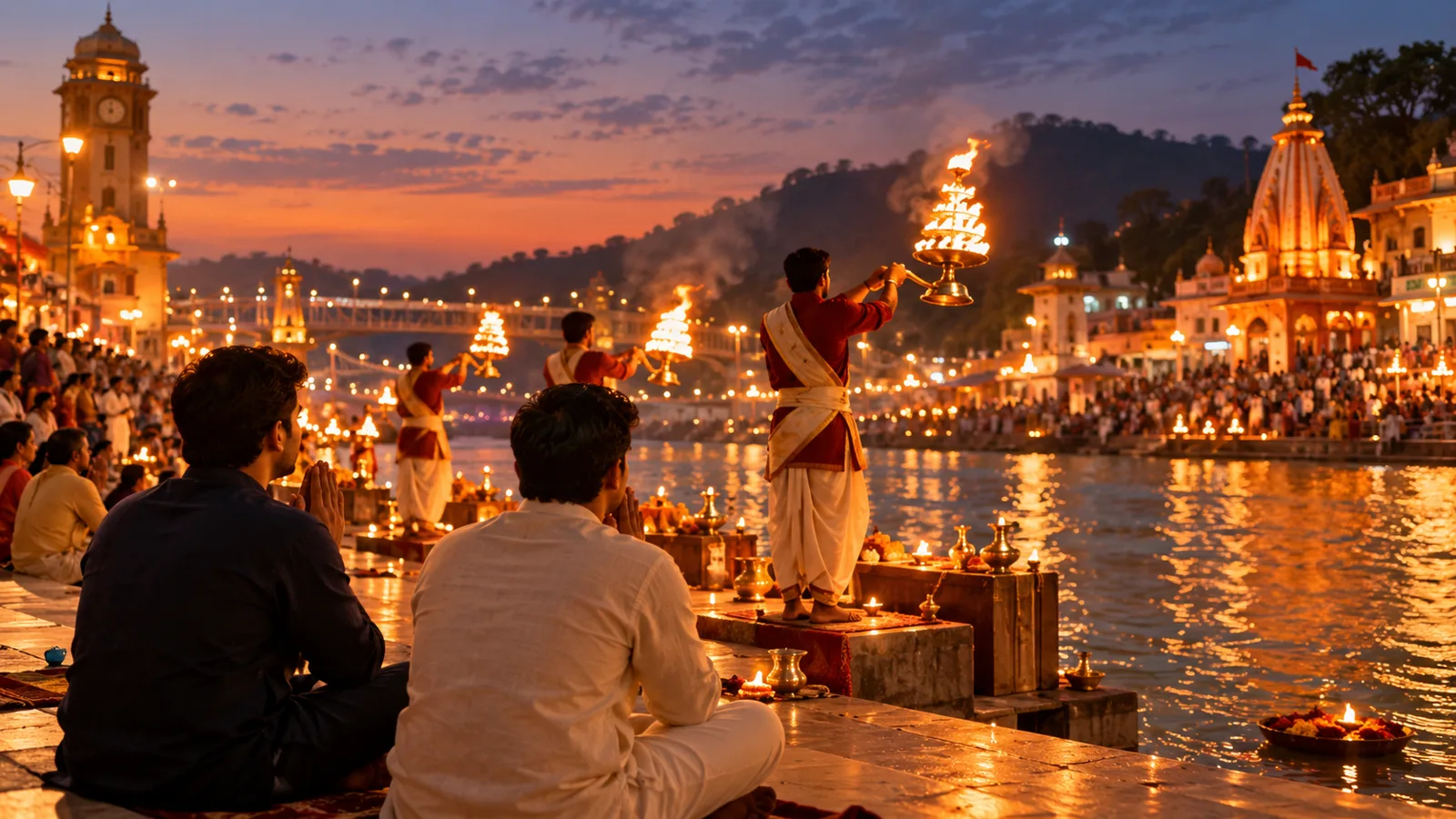
- As dusk descended, we joined the crowds for the iconic Ganga Aarti. This mesmerizing evening prayer ceremony, a ritual of light and sound, is performed as an offering to the Ganges River. With hundreds of oil lamps (diyas) floating on the water, chants echoing, and bells chiming, the atmosphere is utterly electrifying.
- Significance: While a morning Aarti also takes place, the evening Aarti holds much greater significance for many devotees. It marks the poignant transition from day to night, sun to moon, light to dark. In this changing cosmic energy, the evening Aarti is believed to be a powerful invocation, deviating negative energies and infusing us with the spiritual strength and positive energy to face the darkness of the night and the challenges of life. This collective prayer of gratitude, coupled with the dramatic visual spectacle, draws a much larger and more energetic crowd compared to its quieter morning counterpart, making it an unforgettable spiritual experience.
- After soaking in the spiritual ambiance, we indulged in some local street food – a simple, comforting end to a long, emotionally rich day. We retired early, tired but deeply fulfilled.
Day 2: Morning Aarti, Ancestral Rites & Onward to Pehowa (3 October 2025)
Our second day began early with the peaceful sounds of Haridwar’s morning.
Morning Aarti at Har Ki Pauri
- We rose early to attend the morning Aarti, which commences around 6 AM. The contrast to the previous evening’s grandeur was stark. The ghat, normally teeming with devotees, was surprisingly uncrowded, almost empty. This serene atmosphere, while less visually dramatic, offered a different kind of introspection.
- An Unexpected Discovery: We soon learned the reason for the quiet. After Dussehra, the flow of water to the Har Ki Pauri ghats is temporarily diverted for cleaning and maintenance, a practice that continues until just before Diwali. This brief closure ensures the ghats are pristine for the upcoming festive season, explaining the reduced crowds.
- Understanding the Ancestral Rites:
- Purification: Taking a holy dip (Snan) in the Ganges.
- Sankalpa: Making a formal resolution (vow) specifying for whom the Shradh is being performed.
- Invocation: Invoking gods and the ancestors to accept the offerings.
- The rituals performed for departed ancestors are profound and hold immense significance in Sanatan Dharma (Hinduism). Our morning at Haridwar was dedicated to performing some of these vital ceremonies:
- Pind Daan: This is arguably the most well-known ritual performed for the deceased. ‘Pind’ refers to balls of cooked rice and barley flour mixed with sesame seeds (til), which symbolize the physical body of the ancestor. ‘Daan’ means offering. Through Pind Daan, offerings are made to satiate the hunger of the departed soul and to aid its journey towards liberation (moksha). It’s believed that performing Pind Daan helps the soul transcend the earthly plane and attain peace.
- Narayan Bali: This is a specific ritual often performed for those who have died an unnatural death (such as an accident or a sudden death) or whose last rites could not be performed according to tradition. It is essentially a ‘proxy’ ritual to provide salvation and peace to such souls, often invoking Lord Vishnu (Narayana) to guide them. It also helps to pacify any ancestral curses or unsettled karmas.
- Ancestor worship (Tarpan): When performing the annual rites for ancestors, especially during the fortnight of Pitru Paksha, the consecrated water offerings are disposed of at the base of a sacred tree, such as a Peepal. This act directs the blessings to the ancestors and links the sacred water back to the living earth.
- These ceremonies are not merely formalities; they are expressions of deep respect, love, and a sense of duty towards one’s ancestors, ensuring their spiritual well-being and seeking their blessings.
- After the morning Aarti, we moved to a nearby ghat to perform the crucial Pind Daan, Narayan Bali, and other rituals. These ancient ceremonies are performed for the salvation and peace of departed ancestors, offering sustenance and liberation to their souls. A significant part of this ritual involved pouring 40 buckets of water onto a Peepal tree, a sacred tree believed to house the spirits of ancestors, as a symbol of rejuvenation and blessing. This was followed by feeding a cow, an act considered highly meritorious in Hinduism. The entire Puja was a profound, two-hour engagement, deeply connecting us to our ancestral lineage and duties.
Rest & Journey to Pehowa
- Following the intense morning rituals, we returned to our hotel for a much-needed rest.
- By midday, we were ready for our next leg of the journey. We hired another taxi for the approximately 4-hour drive to Pehowa, a journey that cost around ₹3,500.
Pehowa: A Unique Karthikeyan Temple & Final Rites
- We arrived in Pehowa around 3.30 PM. Maintaining our spiritual commitment, we continued our fast until the final ceremonies. Pehowa holds special significance, particularly for its unique Lord Karthikeyan Temple. This is the only Karthikeyan temple where devotees offer oil to the deity, a distinct ritual rarely seen elsewhere, and believed to bring specific blessings related to health and prosperity. We performed our final offerings here, including a single Pind Daan and the pouring of oil, completing the core ancestral rites.
- The ritual’s origin
- According to the local legend, Kartikeya was enraged after his brother, Ganesha, was honored before him.
- In anger, Kartikeya tore off his own skin, leaving his skeleton exposed.
- He then cursed that any woman who saw him in this form would become a widow for seven lifetimes. This is why women are historically prohibited from entering the inner sanctum of the Pehowa temple.
- To calm him and soothe his suffering, the other gods massaged his body with oils and sindoor (vermilion).
- The ritual of pouring oil on the image at the Pehowa temple continues this practice, symbolizing a soothing and calming offering to the deity.
- Spiritual significance
- For ancestors: Devotees believe that pouring oil and showing respect to the deity’s image can help their departed family members attain moksha (liberation from the cycle of death and rebirth).
- Continuing tradition: The practice also commemorates a visit from the Pandava king Yudhishthira, who is said to have visited the temple to pray for the souls of soldiers lost in the Mahabharata war.
Return to Delhi & Amrik Sukhdev Dinner
- Around 5 PM, with our sacred duties fulfilled, we began our return journey to Delhi.
- The drive back took approximately 5 hours, bringing us to Delhi around 11 PM. On the way, we made a crucial stop at Amrik Sukhdev in Murthal. This legendary dhaba lived up to its reputation – it was absolutely packed, even at that late hour! We indulged in some of the best parathas we’d ever tasted, served with a generous dollop of white butter. It was a much-needed, comforting meal after a long and emotionally demanding day.
Delhi: A Leela Ambience Stay
- Exhausted but content, we checked into the Leela Ambience Delhi Hotel. As a GHA Titanium member, I was not upgraded to a better room, but we were granted access to The Royal Club lounge, a welcome perk after our journey.
Day 3 & 4: Delhi Respite & Return Journey (4–5 October 2025)
Our final days brought a change of pace, offering a blend of relaxation, urban exploration, and the journey back home.
Day 3: Exploring Delhi – Culture and Culinary Delights (4 October 2025)
- After a comfortable night at The Leela Ambience, we started our day with breakfast at the hotel.
- Our exploration of Delhi began with a visit to Chandni Chowk, the bustling heart of Old Delhi. Here, we paid our respects at a Gurudwara Sisganj Sahib, partaking in the communal meal (Langer) – a powerful experience of selfless service and community.
- We then immersed ourselves in the vibrant chaos of Chandni Chowk, roaming its narrow lanes filled with an array of goods and street food. The experience was a stark contrast to the spiritual serenity of Haridwar and Pehowa, but equally enriching in its own way.
- Returning to The Leela Ambience, we made use of our Royal Club lounge access. The lounge, though compact, was thoughtfully designed, resembling a comfortable flat with distinct areas. One room served a delightful spread of two vegetarian and two non-vegetarian starters, along with various breads and a sweet dish. The other rooms and the main hall provided ample seating. This relaxed setting allowed us to enjoy a light dinner from the lounge’s offerings before retiring for the night.
Day 4: Fitness, Meetings & Homeward Bound (5 October 2025)
- Our final day started with a visit to the hotel’s gym & Swimming Pool, a personal ritual I enjoy to maintain routine and explore the facilities of hotels I stay in.
- After breakfast, we had brief meetings with some company clients at the hotel, effectively blending personal travel with professional engagements.
- Post-checkout, we made our way to Hindon Airport (Ghaziabad). This small airport, primarily a military airbase, serves as a gateway for specific flights. Unfortunately, our return flight to Chennai was delayed by an hour.
- Despite the delay, we landed in Chennai around 8 PM. From the airport, we utilized the Chennai Metro for our final leg home. A smart tip for readers: booking Metro tickets via WhatsApp messaging often provides a 20% discount, turning a ₹40 ticket into just ₹32 – a small but welcome saving! We finally reached home by 9:30 PM, concluding a journey filled with profound experiences and poignant memories.
Conclusion: A Journey Beyond Points, Rich with Heritage and Heart
Our journey to Haridwar and Pehowa, undertaken for a solemn remembrance, transcended mere travel. It was a profound immersion into the heart of Sanatan Dharma, a tangible connection to our ancestors, and a powerful reminder of the enduring significance of tradition for our generation. From the mesmerizing Ganga Aarti to the ancient ancestral records and the unique rituals in Pehowa, every moment was imbued with spiritual depth and personal meaning.
This experience, while entirely paid, underscored a different facet of ‘smart travel’ – how meticulous planning and the strategic use of premium credit cards can provide comfort, efficiency, and valuable rewards even when redeeming points isn’t the primary goal. It allowed us to focus on the purpose of our pilgrimage, knowing that every expense was also contributing to future aspirational travel.
Such journeys, though born from sorrow, leave an indelible mark, strengthening our ties to family, culture, and our roots. They are reminders that the greatest treasures of travel often lie not in the luxury of a five-star resort, but in the richness of human connection and the depth of spiritual discovery.
Maximizing Paid Travel: Smart Credit Card Choices
While this particular journey was fully paid, it highlighted the importance of using the right financial tools to maximize value. Every flight, hotel, and taxi booking, and even everyday expenses during the trip, contributed to accumulating valuable reward points for future travel. Here are some of the premium credit cards from India that are excellent for earning on paid travel:
- Amex Platinum Charge Card (India): For flights, premium hotel stays, and general spending, the Amex Platinum earns Membership Rewards points at an accelerated rate, which can later be transferred to various airline and hotel partners for aspirational redemptions. Its travel insurance benefits also add peace of mind.
- HDFC Bank Infinia Credit Card: Known for its high reward rate, especially on travel and dining, the Infinia allows you to accumulate points rapidly on paid bookings, which are incredibly flexible for future flights or hotels.
- Axis Bank Magnus for Burgundy: The card we used for this trip. We booked the Chennai–Delhi flight on Axis Bank’s Travel EDGE portal with it, and it earns EDGE Miles that transfer to airline partners at 5:4, plus 35 EDGE Miles per ₹200 once you cross ₹1.5 lakh in a calendar month.
- Other Premium Travel Cards: Any card offering accelerated rewards on travel, dining, or general spending allows you to turn necessary paid travel into future travel opportunities.”
New to earning points on everyday and travel spends? Start with our beginner’s guide to credit card points in India.
Apni jadon se judna bhi ek safar hai. (Reconnecting with our roots is a journey too.)